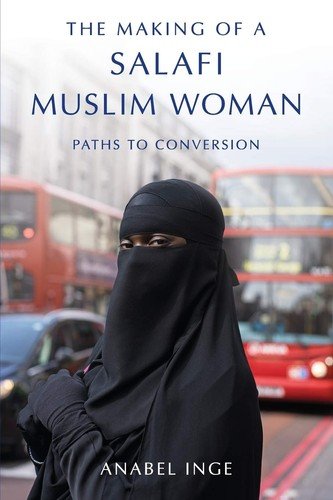

Item specifics
- Condition
- Release Year
- 2018
- ISBN
- 9780190889203
- Book Title
- Making of a Salafi Muslim Woman : Paths to Conversion
- Publisher
- Oxford University Press, Incorporated
- Item Length
- 9.1 in
- Publication Year
- 2018
- Format
- Trade Paperback
- Language
- English
- Illustrator
- Yes
- Item Height
- 0.9 in
- Author
- Anabel Inge
- Genre
- Religion, Social Science
- Topic
- Islamic Studies, General, Women’s Studies, Islam / General
- Item Weight
- 17.6 Oz
- Item Width
- 6.1 in
- Number of Pages
- 320 Pages
- Country of Origin
- United States
THE MAKING OF A SALAFI MUSLIM WOMAN: Paths to Conversion
About this product
Product Identifiers
Publisher
Oxford University Press, Incorporated
ISBN-10
0190889209
ISBN-13
9780190889203
eBay Product ID (ePID)
242541210
Product Key Features
Book Title
Making of a Salafi Muslim Woman : Paths to Conversion
Number of Pages
320 Pages
Language
English
Topic
Islamic Studies, General, Women’s Studies, Islam / General
Publication Year
2018
Illustrator
Yes
Genre
Religion, Social Science
Format
Trade Paperback
Dimensions
Item Height
0.9 in
Item Weight
17.6 Oz
Item Length
9.1 in
Item Width
6.1 in
Additional Product Features
Intended Audience
Trade
Dewey Edition
23
TitleLeading
The
Dewey Decimal
297.8/3
Table Of Content
Note on Arabic Terms, Transliterations, Qur’anic Quotations and Paraphrasing Acknowledgements Introduction Chapter 1 The Development of Salafism in Britain Chapter 2 Fieldwork Chapter 3 Becoming Salafi Chapter 4 Commitment and Belonging: The Role of Circles of Knowledge Chapter 5 Applying Salafism: Negotiating Teachings and Lived Realities Chapter 6 “Marriage Completes Half Your Religion, Sister”: Salafi Match-Making Conclusion Notes Bibliography Glossary Information on Interviewees Interview Question Guide for Salafi Women Index
Synopsis
The spread of Salafism – often referred to as “Wahhabism” – in the West has intrigued and alarmed observers since the attacks of 9/11. Many see it as a fundamentalist interpretation of Islam that condones the subjugation of women and fuels Jihadist extremism. This view depicts Salafi women as the hapless victims of a fanatical version of Islam. Yet in Britain, growing numbers of educated women – often converts or from less conservative Muslim backgrounds – are actively choosing to embrace Salafism’s literalist beliefs and strict regulations, including heavy veiling, wifely obedience, and seclusion from non-related men. How do these young women reconcile such difficult demands with their desire for university education, fulfilling careers, and suitable husbands? How do their beliefs affect their love lives and other relationships? And why do they become Salafi in the first place?Anabel Inge has gained unprecedented access to Salafi women’s groups in the United Kingdom to provide the first in-depth account of their lives. Drawing on more than two years of ethnographic fieldwork in London, she examines why Salafism is attracting so many young Somalis, Afro-Caribbean converts, and others. But she also reveals the personal dilemmas they confront. This ground-breaking, lucid, and richly detailed book will be of vital interest to scholars, policy-makers, journalists, and general readers., Salafism, often called “Wahhabism,” is widely seen as a fundamentalist interpretation of Islam that subjugates women, yet growing numbers of young British women, many of them converts or from less conservative Muslim backgrounds, are actively embracing it. With unprecedented access to Salafi women’s groups in the UK, Anabel Inge provides the first in-depth account of their lives, probing the reasons for their conversion and their subsequent dilemmas and difficulties., The spread of Salafism–often referred to as “Wahhabism”–in the West has intrigued and alarmed observers since the attacks of 9/11. Many see it as a fundamentalist interpretation of Islam that condones the subjugation of women and fuels Jihadist extremism. This view depicts Salafi women as the hapless victims of a fanatical version of Islam. Yet in Britain, growing numbers of educated women–often converts or from less conservative Muslim backgrounds-are activelychoosing to embrace Salafism’s literalist beliefs and strict regulations, including heavy veiling, wifely obedience, and seclusion from non-related men. How do these young women reconcile such difficultdemands with their desire for university education, fulfilling careers, and suitable husbands? How do their beliefs affect their love lives and other relationships? And why do they become Salafi in the first place?Anabel Inge has gained unprecedented access to Salafi women’s groups in the United Kingdom to provide the first in-depth account of their lives. Drawing on more than two years of ethnographic fieldwork in London, she examines why Salafism is attracting so manyyoung Somalis, Afro-Caribbean converts, and others. But she also reveals the personal dilemmas they confront. This ground-breaking, lucid, and richly detailed book will be of vital interest to scholars,policy-makers, journalists, and general readers., The spread of Salafism–often referred to as “Wahhabism”–in the West has intrigued and alarmed observers since the attacks of 9/11. Many see it as a fundamentalist interpretation of Islam that condones the subjugation of women and fuels Jihadist extremism. This view depicts Salafi women as the hapless victims of a fanatical version of Islam. Yet in Britain, growing numbers of educated women–often converts or from less conservative Muslim backgrounds-are actively choosing to embrace Salafism’s literalist beliefs and strict regulations, including heavy veiling, wifely obedience, and seclusion from non-related men. How do these young women reconcile such difficult demands with their desire for university education, fulfilling careers, and suitable husbands? How do their beliefs affect their love lives and other relationships? And why do they become Salafi in the first place? Anabel Inge has gained unprecedented access to Salafi women’s groups in the United Kingdom to provide the first in-depth account of their lives. Drawing on more than two years of ethnographic fieldwork in London, she examines why Salafism is attracting so many young Somalis, Afro-Caribbean converts, and others. But she also reveals the personal dilemmas they confront. This ground-breaking, lucid, and richly detailed book will be of vital interest to scholars, policy-makers, journalists, and general readers.
LC Classification Number
BP195.S18I54 2018
Price : 37.39
Ends on : N/A
View on eBay