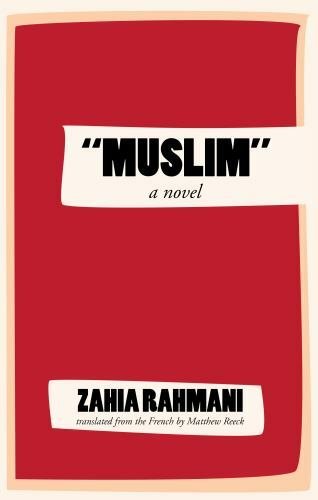

Item specifics
- Condition
- Very GoodA book that does not look new and has been read but is in excellent condition. No obvious damage to the cover, with the dust jacket (if applicable) included for hard covers. No missing or damaged pages, no creases or tears, and no underlining/highlighting of text or writing in the margins. May be very minimal identifying marks on the inside cover. Very minimal wear and tear. See the seller’s listing for full details and description of any imperfections. See all condition definitionsopens in a new window or tab
- Seller Notes
- Binding
- Paperback
- Weight
- 0 lbs
- Product Group
- Book
- IsTextBook
- No
- ISBN
- 9781941920756
- Book Title
- Muslim : a Novel
- Publisher
- Deep Vellum Publishing
- Item Length
- 4.7 in
- Publication Year
- 2019
- Format
- Trade Paperback
- Language
- English
- Item Height
- 0.4 in
- Author
- Zahia Rahmani
- Genre
- Fiction
- Topic
- Religious, Literary
- Item Weight
- 4.2 Oz
- Item Width
- 7 in
- Number of Pages
- 145 Pages
- Country of Origin
- United States
Muslim by Rahmani, Zahia
About this product
Product Identifiers
Publisher
Deep Vellum Publishing
ISBN-10
1941920756
ISBN-13
9781941920756
eBay Product ID (ePID)
2309444728
Product Key Features
Book Title
Muslim : a Novel
Number of Pages
145 Pages
Language
English
Publication Year
2019
Topic
Religious, Literary
Genre
Fiction
Format
Trade Paperback
Dimensions
Item Height
0.4 in
Item Weight
4.2 Oz
Item Length
4.7 in
Item Width
7 in
Additional Product Features
Intended Audience
Trade
Reviews
“A love letter to us: the outcasts, the hyphenated “others,” those who have lost tongues and gained dialects. Zahia Rahmani speaks to the religious fairy tales of my girlhood, the Muslim lore we listened to while learning the Arabic alphabet. ‘Muslim’ challenges the borders of genre, much like Rahmani pushes up against the boundaries of multiple, overlapping identities, investigating imposed definitions and complicating what it means to be colonized, woman, Muslim.” — Dr. Seema Yasmin , author, For Filthy Women Who Worry About Disappointing God & The Impatient Dr. Lange: One Man’s Fight to End the Global HIV Epidemic “‘I was born into a minor language and escaped from a distant nowhere that didn’t want me,’ Zahia Rahmani writes in this chronicle of the numerous forms isolation can take–and the numerous ways that identity can be both claimed and projected onto someone. This novel is brief in length, but Rahmani’s approach to it allows for a constant mutability of its form and a series of limitless stylistic renewals.” Tobias Carroll, Words Without Borders, “A love letter to us: the outcasts, the hyphenated “others,” those who have lost tongues and gained dialects. Zahia Rahmani speaks to the religious fairy tales of my girlhood, the Muslim lore we listened to while learning the Arabic alphabet. ‘Muslim’ challenges the borders of genre, much like Rahmani pushes up against the boundaries of multiple, overlapping identities, investigating imposed definitions and complicating what it means to be colonized, woman, Muslim.” — Dr. Seema Yasmin , author, For Filthy Women Who Worry About Disappointing God & The Impatient Dr. Lange: One Man’s Fight to End the Global HIV Epidemic, One of Words Without Borders’ most anticipated books of 2019 Part of the New York Times Globetrotting feature on upcoming 2019 Translations Included in Translated Lit’s Most Anticipated Books of February 2019 Librairie Drawn & Quarterly’s New & Notable books Included in Electric Literature’s “20 Small Press Books You Might Have Missed” Finalist for Big Other’s Book Award for Translation “A love letter to us: the outcasts, the hyphenated “others,” those who have lost tongues and gained dialects. Zahia Rahmani speaks to the religious fairy tales of my girlhood, the Muslim lore we listened to while learning the Arabic alphabet. “Muslim” challenges the borders of genre, much like Rahmani pushes up against the boundaries of multiple, overlapping identities, investigating imposed definitions and complicating what it means to be colonized, woman, Muslim.” – Dr. Seema Yasmin “‘I was born into a minor language and escaped from a distant nowhere that didn’t want me,’ Zahia Rahmani writes in this chronicle of the numerous forms isolation can take–and the numerous ways that identity can be both claimed and projected onto someone. This novel is brief in length, but Rahmani’s approach to it allows for a constant mutability of its form and a series of limitless stylistic renewals.” – Tobias Carroll, Words Without Borders “This is the ethical and political terrain at stake for Rahmani, whose literary fiction is an instrument for truths that as yet have nowhere else to be heard. That the very nature of our political regimes requires intervention by way of fiction suggests that literature has an indispensable role to play in the ongoing work of justice.”- Jill Jarvis, Public Books “Absolutely essential reading.” –Lyric Hunter, Brazos Bookstore “The role of myth and archetypes, identitarian persecution, faith, movement through borderlands, naming, and the limitations and potential of particular languages all figure into this autobiographical novel.”–Aaron Robertson, Lit Hub, One of Words Without Borders’ most anticipated books of 2019 Part of the New York Times Globetrotting feature on upcoming 2019 Translations Included in Translated Lit’s Most Anticipated Books of February 2019 Librairie Drawn & Quarterly’s New & Notable books Included in Electric Literature’s “20 Small Press Books You Might Have Missed” Finalist for Big Other’s Book Award for Translation “A love letter to us: the outcasts, the hyphenated “others,” those who have lost tongues and gained dialects. Zahia Rahmani speaks to the religious fairy tales of my girlhood, the Muslim lore we listened to while learning the Arabic alphabet. “Muslim” challenges the borders of genre, much like Rahmani pushes up against the boundaries of multiple, overlapping identities, investigating imposed definitions and complicating what it means to be colonized, woman, Muslim.” – Dr. Seema Yasmin “‘I was born into a minor language and escaped from a distant nowhere that didn’t want me,’ Zahia Rahmani writes in this chronicle of the numerous forms isolation can take–and the numerous ways that identity can be both claimed and projected onto someone. This novel is brief in length, but Rahmani’s approach to it allows for a constant mutability of its form and a series of limitless stylistic renewals.” – Tobias Carroll, Words Without Borders “This is the ethical and political terrain at stake for Rahmani, whose literary fiction is an instrument for truths that as yet have nowhere else to be heard. That the very nature of our political regimes requires intervention by way of fiction suggests that literature has an indispensable role to play in the ongoing work of justice.”- Jill Jarvis, Public Books “Absolutely essential reading.” – Lyric Hunter, Brazos Bookstore, Winner of the Albertine Prize 2020 One of Words Without Borders’ most anticipated books of 2019 Part of the New York Times Globetrotting feature on upcoming 2019 Translations Included in Translated Lit’s Most Anticipated Books of February 2019 Librairie Drawn & Quarterly’s New & Notable books Included in Electric Literature’s “20 Small Press Books You Might Have Missed” Finalist for Big Other’s Book Award for Translation “A love letter to us: the outcasts, the hyphenated “others,” those who have lost tongues and gained dialects. Zahia Rahmani speaks to the religious fairy tales of my girlhood, the Muslim lore we listened to while learning the Arabic alphabet. “Muslim” challenges the borders of genre, much like Rahmani pushes up against the boundaries of multiple, overlapping identities, investigating imposed definitions and complicating what it means to be colonized, woman, Muslim.” – Dr. Seema Yasmin “‘I was born into a minor language and escaped from a distant nowhere that didn’t want me,’ Zahia Rahmani writes in this chronicle of the numerous forms isolation can take–and the numerous ways that identity can be both claimed and projected onto someone. This novel is brief in length, but Rahmani’s approach to it allows for a constant mutability of its form and a series of limitless stylistic renewals.” – Tobias Carroll, Words Without Borders “This is the ethical and political terrain at stake for Rahmani, whose literary fiction is an instrument for truths that as yet have nowhere else to be heard. That the very nature of our political regimes requires intervention by way of fiction suggests that literature has an indispensable role to play in the ongoing work of justice.”- Jill Jarvis, Public Books “Absolutely essential reading.” –Lyric Hunter, Brazos Bookstore “The role of myth and archetypes, identitarian persecution, faith, movement through borderlands, naming, and the limitations and potential of particular languages all figure into this autobiographical novel.”–Aaron Robertson, Lit Hub, “A love letter to us: the outcasts, the hyphenated “others,” those who have lost tongues and gained dialects. Zahia Rahmani speaks to the religious fairy tales of my girlhood, the Muslim lore we listened to while learning the Arabic alphabet. ‘Muslim’ challenges the borders of genre, much like Rahmani pushes up against the boundaries of multiple, overlapping identities, investigating imposed definitions and complicating what it means to be colonized, woman, Muslim.” — Dr. Seema Yasmin , author, For Filthy Women Who Worry About Disappointing God & The Impatient Dr. Lange: One Man’s Fight to End the Global HIV Epidemic “‘I was born into a minor language and escaped from a distant nowhere that didn’t want me,’ Zahia Rahmani writes in this chronicle of the numerous forms isolation can take–and the numerous ways that identity can be both claimed and projected onto someone. This novel is brief in length, but Rahmani’s approach to it allows for a constant mutability of its form and a series of limitless stylistic renewals.” Tobias Carroll, Words Without Borders “This is the ethical and political terrain at stake for Rahmani, whose literary fiction is an instrument for truths that as yet have nowhere else to be heard. That the very nature of our political regimes requires intervention by way of fiction suggests that literature has an indispensable role to play in the ongoing work of justice.”– Jill Jarvis Public Books, One of Words Without Borders’ most anticipated books of 2019 Part of the New York Times Globetrotting feature on upcoming 2019 Translations Included in Translated Lit’s Most Anticipated Books of February 2019 Librairie Drawn & Quarterly’s New & Notable books Included in Electric Literature’s “20 Small Press Books You Might Have Missed” Finalist for Big Other’s Book Award for Translation One of five titles shortlisted for the 2020 Albertine Prize “A love letter to us: the outcasts, the hyphenated “others,” those who have lost tongues and gained dialects. Zahia Rahmani speaks to the religious fairy tales of my girlhood, the Muslim lore we listened to while learning the Arabic alphabet. “Muslim” challenges the borders of genre, much like Rahmani pushes up against the boundaries of multiple, overlapping identities, investigating imposed definitions and complicating what it means to be colonized, woman, Muslim.” – Dr. Seema Yasmin “‘I was born into a minor language and escaped from a distant nowhere that didn’t want me,’ Zahia Rahmani writes in this chronicle of the numerous forms isolation can take–and the numerous ways that identity can be both claimed and projected onto someone. This novel is brief in length, but Rahmani’s approach to it allows for a constant mutability of its form and a series of limitless stylistic renewals.” – Tobias Carroll, Words Without Borders “This is the ethical and political terrain at stake for Rahmani, whose literary fiction is an instrument for truths that as yet have nowhere else to be heard. That the very nature of our political regimes requires intervention by way of fiction suggests that literature has an indispensable role to play in the ongoing work of justice.”- Jill Jarvis, Public Books “Absolutely essential reading.” –Lyric Hunter, Brazos Bookstore “The role of myth and archetypes, identitarian persecution, faith, movement through borderlands, naming, and the limitations and potential of particular languages all figure into this autobiographical novel.”–Aaron Robertson, Lit Hub
Dewey Edition
23
Dewey Decimal
843.92
Synopsis
Muslim: A Novel is a genre-bending, poetic reflection on what it means to be Muslim from one of France’s leading writers. In this novel, the second in a trilogy, Rahmani’s narrator contemplates the loss of her native language and her imprisonment and exile for being Muslim, woven together in an exploration of the political and personal relationship of language within the fraught history of Islam. Drawing inspiration from the oral histories of her native Berber language, the Koran, and French children’s tales, Rahmani combines fiction and lyric essay in to tell an important story, both powerful and visionary, of identity, persecution, and violence., Fiction and lyric essay combine in Zahia Rahmani’s poetic reflection on Islamic history and what it means to be Muslim., “Muslim” A Novel is a genre-bending, poetic reflection on what it means to be Muslim from one of France’s leading writers. In this novel, the second in a trilogy, Rahmani’s narrator contemplates the loss of her native language and her imprisonment and exile for being Muslim, woven together in an exploration of the political and personal relationship of language within the fraught history of Islam. Drawing inspiration from the oral histories of her native Berber language, the Koran, and French children’s tales, Rahmani combines fiction and lyric essay in to tell an important story, both powerful and visionary, of identity, persecution, and violence.
LC Classification Number
PQ2718.A36
Price : 9.37
Ends on : N/A
View on eBay