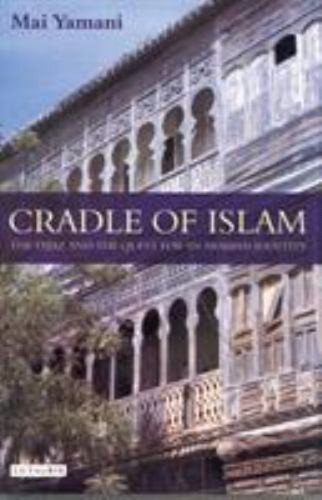

Item specifics
- Condition
- Very GoodA book that does not look new and has been read but is in excellent condition. No obvious damage to the cover, with the dust jacket (if applicable) included for hard covers. No missing or damaged pages, no creases or tears, and no underlining/highlighting of text or writing in the margins. May be very minimal identifying marks on the inside cover. Very minimal wear and tear. See the seller’s listing for full details and description of any imperfections. See all condition definitionsopens in a new window or tab
- Seller Notes
- Publication Name
- I. B. Tauris & Company, Limited
- ISBN
- 9781845118242
- Book Title
- Cradle of Islam : the Hijaz and the Quest for an Arabian Identity
- Publisher
- I. B. Tauris & Company, The Limited
- Item Length
- 9.1 in
- Publication Year
- 2009
- Format
- Trade Paperback
- Language
- English
- Illustrator
- Yes
- Item Height
- 0.8 in
- Author
- Mai Yamani
- Genre
- Religion, History
- Topic
- Islam / General, Middle East / Arabian Peninsula, Middle East / General
- Item Weight
- 13.8 Oz
- Item Width
- 9.1 in
- Number of Pages
- 248 Pages
Cradle of Islam : The Hijaz and the Quest for an Arabian Identity
About this product
Product Identifiers
Publisher
I. B. Tauris & Company, The Limited
ISBN-10
1845118243
ISBN-13
9781845118242
eBay Product ID (ePID)
71886687
Product Key Features
Book Title
Cradle of Islam : the Hijaz and the Quest for an Arabian Identity
Number of Pages
248 Pages
Language
English
Publication Year
2009
Topic
Islam / General, Middle East / Arabian Peninsula, Middle East / General
Illustrator
Yes
Genre
Religion, History
Format
Trade Paperback
Dimensions
Item Height
0.8 in
Item Weight
13.8 Oz
Item Length
9.1 in
Item Width
9.1 in
Additional Product Features
Intended Audience
Trade
Reviews
“Mai Yamani is consistently the sharpest observer of modern Saudi Arabia and paints a vivid picture of the cauldron of political and religious divisions that are tearing it apart. This is a major contribution to the study of Arab diversity — at a time when the West urgently needs to understand it.” — Tim Sebastian, BBC Hard Talk “My father was born in Mecca and much of what I have read here reminds me of my father, grandfather and relations. Mai Yamani has provided us with a unique perspective on the Hijaz. This is an invaluable contribution to the social and political history of a hitherto largely unknown, ignored and unrecognised people. An irrefutably powerful argument for the preservation of cultural identity, respect for human dignity and a celebration of our human diversity.” — HRH Prince Hassan of Jordan “Definitely authoritative, thought-provoking and refreshing…revealing book…a fascinating read…a unique access to a rather unknown area of diversity and cultural richness.” – Iftikhar H. Malik, The Muslim World Book Review, “Mai Yamani is consistently the sharpest observer of modern Saudi Arabia and paints a vivid picture of the cauldron of political and religious divisions that are tearing it apart. This is a major contribution to the study of Arab diversity — at a time when the West urgently needs to understand it.” — Tim Sebastian, BBC Hard Talk “My father was born in Mecca and much of what I have read here reminds me of my father, grandfather and relations. Mai Yamani has provided us with a unique perspective on the Hijaz. This is an invaluable contribution to the social and political history of a hitherto largely unknown, ignored and unrecognised people. An irrefutably powerful argument for the preservation of cultural identity, respect for human dignity and a celebration of our human diversity.” — HRH Prince Hassan of Jordan, “Mai Yamani is consistently the sharpest observer of modern Saudi Arabia and paints a vivid picture of the cauldron of political and religious divisions that are tearing it apart. This is a major contribution to the study of Arab diversity — at a time when the West urgently needs to understand it.” — Tim Sebastian, BBC Hard Talk”My father was born in Mecca and much of what I have read here reminds me of my father, grandfather and relations. Mai Yamani has provided us with a unique perspective on the Hijaz. This is an invaluable contribution to the social and political history of a hitherto largely unknown, ignored and unrecognised people. An irrefutably powerful argument for the preservation of cultural identity, respect for human dignity and a celebration of our human diversity.” — HRH Prince Hassan of Jordan
Dewey Edition
22
Dewey Decimal
953.8
Synopsis
Is Saudi Arabia really a homogeneous Wahhabi dominated state? In 1932 the Al Saud family incorporated the kingdom of Hijaz, once the cultural hub of the Arabian world, in to the kingdom of Saudi Arabia. The urban, cosmopolitan Hijazis were absorbed in to a new state whose codes of behavior and rules were determined by the Najdis, an ascetic desert people, from whom the Al Saud family came. But the Saudi rulers failed to fully integrate the Hijaz, which retains a distinctive identity to this day. In “Cradle of Islam”, the product of years spent in Mecca, Medina, Jeddah and Taif, Mai Yamani traces the fortunes of the distinctive and resilient culture of the Hijazis, from the golden age of Hashemite Mecca to Saudi domination to its current resurgence. The Hijazis today emphasise their regional heritage in religious ritual, food, dress and language as a response to the ‘Najdification’ of everyday life. The Hijazi experience shows the vitality of cultural diversity in the face of political repression in the Arab world., Is Saudi Arabia really a homogeneous Wahhabi dominated state? In 1932 the Al Saud family incorporated the kingdom of Hijaz, once the cultural hub of the Arabian world, in to the kingdom of Saudi Arabia. The urban, cosmopolitan Hijazis were absorbed in to a new state whose codes of behavior and rules were determined by the Najdis, an ascetic desert people, from whom the Al Saud family came. But the Saudi rulers failed to fully integrate the Hijaz, which retains a distinctive identity to this day. In Cradle of Islam, the product of years spent in Mecca, Medina, Jeddah and Taif, Mai Yamani traces the fortunes of the distinctive and resilient culture of the Hijazis, from the golden age of Hashemite Mecca to Saudi domination to its current resurgence. The Hijazis today emphasise their regional heritage in religious ritual, food, dress and language as a response to the ‘Najdification’ of everyday life. The Hijazi experience shows the vitality of cultural diversity in the face of political repression in the Arab world.
LC Classification Number
DS247.9.H45
Price : 44.29
Ends on : N/A
View on eBay