
Item specifics
- Condition
- Release Year
- 2002
- ISBN
- 9780742500273
- Book Title
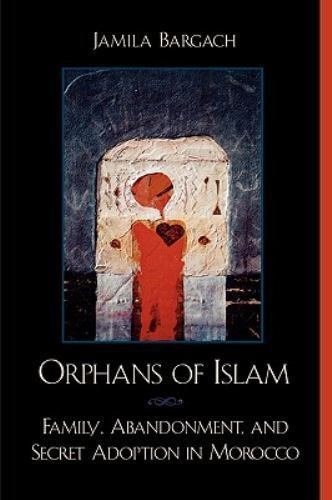
- Orphans of Islam : Family, Abandonment, and Secret Adoption in Morocco
- Book Series
- Alterations Ser.
- Publisher
- Bloomsbury Publishing USA
- Item Length
- 9 in
- Publication Year
- 2002
- Format
- Trade Paperback
- Language
- English
- Illustrator
- Yes
- Item Height
- 0.6 in
- Author
- Jamila Bargach
- Genre
- Family & Relationships, Social Science
- Topic
- Children’s Studies, Anthropology / Cultural & Social, Customs & Traditions, Adoption & Fostering, Sociology / Marriage & Family
- Item Weight
- 14.7 Oz
- Item Width
- 6 in
- Number of Pages
- 310 Pages
- Country of Origin
- United States
Orphans Of Islam: Family, Abandonment, And Secret Adoption In Morocco (Alter…
About this product
Product Identifiers
Publisher
Bloomsbury Publishing USA
ISBN-10
0742500276
ISBN-13
9780742500273
eBay Product ID (ePID)
1850144
Product Key Features
Book Title
Orphans of Islam : Family, Abandonment, and Secret Adoption in Morocco
Number of Pages
310 Pages
Language
English
Topic
Children’s Studies, Anthropology / Cultural & Social, Customs & Traditions, Adoption & Fostering, Sociology / Marriage & Family
Publication Year
2002
Illustrator
Yes
Genre
Family & Relationships, Social Science
Book Series
Alterations Ser.
Format
Trade Paperback
Dimensions
Item Height
0.6 in
Item Weight
14.7 Oz
Item Length
9 in
Item Width
6 in
Additional Product Features
Intended Audience
Trade
LCCN
2001-031989
Reviews
Orphans of Islam succeeds as a combination rich ethnography and sophisticated theoretical analysis. Bargach does an exceptional job of capturing and translating the eloquence of her interlocutors. …a book that demonstrates the merits of writing anthropology that attends to the local and the global, the textual and embodied, and the ascetics and politics of ethnographic representation., [Bargach’s] book is a vital pioneering foundation that could continue to affect social change. I hope that she will continue and others will build and apply this information, bringing society to a higher level and these victims of society closer to social justice and to the basic human dignity of belonging and connection that every person deserves., Through incisive analysis, disciplined passion, and moving prose, Jamila Bargach exposes in this book some of the hidden ambiguities of culture, religion, and power in her own society to the light of thoughtful compassion and humanizing possibilities of redress. This is a truly courageous and inspiring book, confronting silent conspiracies of shame and victimization of innocence with the transforming power of love and truth to enable human agency to overcome its own limitations. An eye opener to see injustice where least acknowledged, and an empowering voice for the oppressed everywhere., This is a fine example of how meticulous ethnography of extraordinary power is ‘found’ in the course of fieldwork that is both rigorous and guided by profound personal connection. Bargach has caught Moroccan society in a revealing contradiction and produces an account from it that is both ethical and honorable., “This is a fine example of how meticulous ethnography of extraordinary power is ‘found’ in the course of fieldwork that is both rigorous and guided by profound personal connection. Bargach has caught Moroccan society in a revealing contradiction and produces an account from it that is both ethical and honorable.” –George Marcus, Rice University ” Orphans of Islam succeeds as a combination rich ethnography and sophisticated theoretical analysis. Bargach does an exceptional job of capturing and translating the eloquence of her interlocutors. …a book that demonstrates the merits of writing anthropology that attends to the local and the global, the textual and embodied, and the ascetics and politics of ethnographic representation.” — Anthropological Quarterly “[Bargach’s] book is a vital pioneering foundation that could continue to affect social change. I hope that she will continue and others will build and apply this information, bringing society to a higher level and these victims of society closer to social justice and to the basic human dignity of belonging and connection that every person deserves.” –Mahasin Saleh, University of Houston, International Journal of Middle East Studies “Through incisive analysis, disciplined passion, and moving prose, Jamila Bargach exposes in this book some of the hidden ambiguities of culture, religion, and power in her own society to the light of thoughtful compassion and humanizing possibilities of redress. This is a truly courageous and inspiring book, confronting silent conspiracies of shame and victimization of innocence with the transforming power of love and truth to enable human agency to overcome its own limitations. An eye opener to see injustice where least acknowledged, and an empowering voice for the oppressed everywhere.” –Abdullahi Ahmed An-Na’im, Emory University School of Law
Series Volume Number
2
Table Of Content
Chapter 1 Notes on Transliteration and Transcription Chapter 2 Preface and Acknowledgements Part 3 Introduction(s): Object/Subject, Discipline/Argument Part 4 I: Defining Moves: From Text to Script and From Script to Text Chapter 5 1 Legal Throes: Genealogies and Debates of Kafala, Adoption, and Abandoned Children Chapter 6 2 Counterpoints: The Idiom of Adoption between Theological Interpretation, the Rise of the Nation-State and the “Real” Part 7 II: Rootless Lives and Bloodless Ties: Bastards, Secret Adoptions, and Some Other Cultural Dialectics Chapter 8 3 Of Anthropology: Nature, Nurture, and Kinship Chapter 9 4 Of Rituals: Names, Affiliation, and Identity Chapter 10 5 Of Culture: Loci, Lore, and Stereotypes Part 11 III: Nothing Above Family: To Reflect on Marginality Chapter 12 6 News From the Art, Intellectual and Media Fronts: Reflections on and Representations of Marginality Chapter 13 7 Social Work at Work: Or What Politics for What Help? Chapter 14 8 Civil Society and Social Work: Or the Politics of What Help? (Continued) Part 15 Postface Chapter 16 Notes Chapter 17 Index
Synopsis
Orphans of Islam portrays the abject lives and ‘excluded body’ of abandoned and bastard children in contemporary Morocco, while critiquing the concept and practice of ‘adoption, ‘ which too often is considered a panacea. Through a close and historically grounded reading of legal, social, and cultural mechanisms of one predominantly Islamic country, Jamila Bargach shows how ‘the surplus bastard body’ is created by mainstream society., Orphans of Islam portrays the abject lives and “excluded body” of abandoned and bastard children in contemporary Morocco, while critiquing the concept and practice of “adoption,” which too often is considered a panacea. Through a close and historically grounded reading of legal, social, and cultural mechanisms of one predominantly Islamic country, Jamila Bargach shows how “the surplus bastard body” is created by mainstream society. Written in part from the perspectives of the children and single mothers, intermittently from the view of “adopting” families, and employing bastardy as a haunting and empowering motif with a potentially subversive edge, this ethnography is composed as an intricate, open-ended, and arabesque-like evocation of Moroccan society and its state institutions. It equally challenges received sociological and anthropological tropes and understandings of the Arab world., Orphans of Islam portrays the abject lives and ‘excluded body’ of abandoned and bastard children in contemporary Morocco, while critiquing the concept and practice of ‘adoption,’ which too often is considered a panacea. Through a close and historically grounded reading of legal, social, and cultural mechanisms of one predominantly Islamic country, Jamila Bargach shows how ‘the surplus bastard body’ is created by mainstream society. Written in part from the perspectives of the children and single mothers, intermittently from the view of ‘adopting’ families, and employing bastardy as a haunting and empowering motif with a potentially subversive edge, this ethnography is composed as an intricate, open-ended, and arabesque-like evocation of Moroccan society and its state institutions. It equally challenges received sociological and anthropological tropes and understandings of the Arab world., Orphans of Islam portrays the abject lives and ‘excluded body’ of abandoned and bastard children in contemporary Morocco, while critiquing the concept and practice of ‘adoption, ‘ which too often is considered a panacea. Through a close and historically grounded reading of legal, social, and cultural mechanisms of one predominantly Islamic country, Jamila Bargach shows how ‘the surplus bastard body’ is created by mainstream society. Written in part from the perspectives of the children and single mothers, intermittently from the view of ‘adopting’ families, and employing bastardy as a haunting and empowering motif with a potentially subversive edge, this ethnography is composed as an intricate, open-ended, and arabesque-like evocation of Moroccan society and its state institutions. It equally challenges received sociological and anthropological tropes and understandings of the Arab world, Orphans of Islam portrays the abject lives and ‘excluded body’ of abandoned and bastard children in contemporary Morocco, while critiquing the concept and practice of ‘adoption,’ which too often is considered a panacea. Through a close and historically grounded reading of legal, social, and cultural mechanisms of one predominantly Islamic country, Jamila Bargach shows how ‘the surplus bastard body’ is created by mainstream society.
LC Classification Number
HV875.58.M8B37 2001
Price : 47.45
Ends on : N/A
View on eBay